


Many moons ago when I was working at the Edinburgh deli Valvona and Crolla I was complimented by a wine writer on my sense of smell. As the waitress I was serving rosy glasses of grenache wines to an eager audience. I’m never backward in coming forward and piped up with various aromas I found. Knowing me I was likely having a few cheeky sips as well.
My budding vocation as a cheese buyer lasted two years before I ventured on to The Vaults and stumbled upon single cask, cask strength Scotch whisky. Once again my nosing abilities were noted by Charlie MacLean during a day at Society Whisky School. Charlie chaired the weekly tasting panels where our task was to describe what we encountered in the glass. The Society tasting notes are renowned. ‘Wet spaniel on an Islay beach’. ‘Orange oil on a wetsuit’.
My first attempts at describing what I nosed in the glass were decidedly timid. Smoke, fruit, floral? Like many novices I was cautious to verbalise what I found, but that my first impression was usually in line with what Charlie found. Where he found crisp acidity I described lemon posset, creamy American oak I described Victoria sponge. He honed my narrative. A blast of phenols. But was it maple cured bacon or an old fashioned medicine
cabinet?
Aromas we have encountered growing up are embedded in our memory like a fingerprint and are linked to the experience of emotion we encounter when we identify it. Our vocabulary is formulated from these encounters and used to dissect and describe aroma and taste. The language we use can be hedonistic or analytical.
At the Society, I had found my vocation and I became an earnest student, my holidays revolved around camping trips around the distillery map of Scotland. I would load up the clapped out company car with my tent and a plan of distilleries to visit. My epiphany dram was Lagavulin 16 YO in the Palm Court bar in the Balmoral Hotel. It made sense to make Islay my first pilgrimage. I wrote in my diary that I was ‘completely charmed by the island and the industry I have found myself in!’ I found a good spot at Kintra farm overlooking the Big Strand in early summer sunlight. A light wind kept the midges at bay and I had poured a dram of Ardbeg 17 YO. As I flash fried my langoustines, sipping my dram, a pod of porpoise wove through the breaking waves. When I put my nose into a glass of Ardbeg this is the memory I recall vividly. The salty breeze off the sea, warm sand and machir. A dram and a sizzling pan.
On the same holiday as I gathered experiences like shells on the beach, my vocabulary grew. A couple of years later I returned with my Society friend who I had introduced to camping. We arrived at Lagavulin on my birthday and during the tour I spotted a small cask with the year of my birth stencilled on the end. Pinkie was delighted and wasted no time in pulling a sample which we collectively inhaled from the flask. Reverently, we absorbed the
aromas of dank warehouse, salt laden air, musty bungcloths. Spirit maturing in oak and all of that captured in that moment. On the tour was SMWS member number one who invited us both for tea on his boat moored in Lagavulin bay. A couple of years later I returned to the warehouse with Pinkie but the cask had gone. But not my memory.
Your sense of smell is like a time machine filing away memories like a rolodex of aromas and their associations. A waft of scent under your nose can evoke the long-term memory triggering the neural pathways to the lower brain. The limbic system has evolved linking our emotional response to scent.
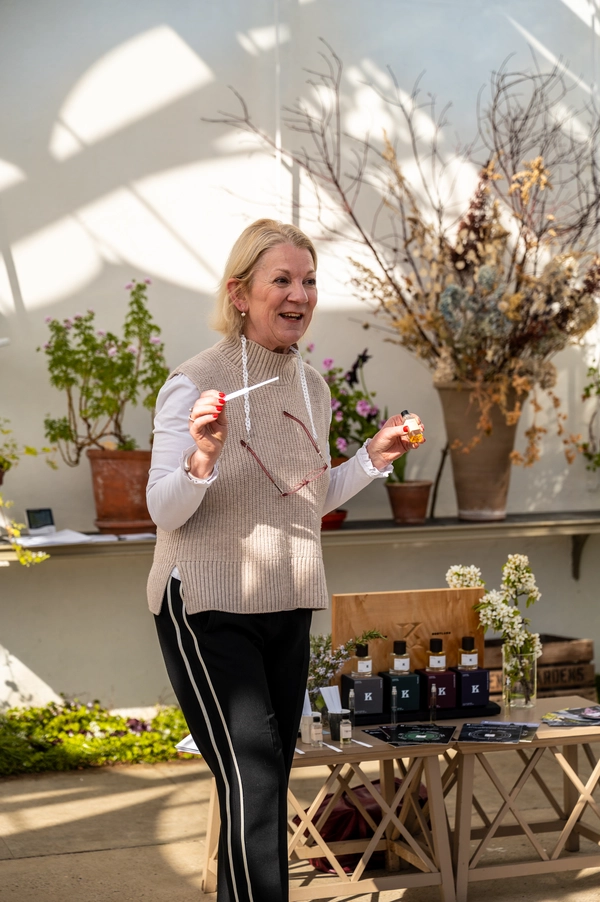
In 2007, I started my role as Global Brand Ambassador for Glenmorangie. My business card pronounced I was a ‘sensory whisky creator’ which invited an array of responses. Around the same time I met Imogen Russon-Taylor who was Head of Global Brand Communications. The ‘new world’ of Glenmorangie was about to be released after years of precision development. The Whisky Creation team led by Dr Bill Lumsden worked with perfumier Dr George Dodd. I’d encountered George a few years before when Charlie and I partook in a workshop to create our own fragrance. Charlie’s was inspired by whisky and was woody, spicy and well whiskyish. Mine was an extraordinary experiment as I dabbled with peach oil. I can’t remember the ingredients but strangers would stop me to ask what it was.
The ‘Kaleidoscope’ was created after using gas chromatography to analyse the burst of aromas from the spirit, imagery was used to describe vibrant top notes, floral heart notes and heavier base notes. As a trained artist and the only member of the team without a chemistry background I enthusiastically shared the ‘Kaleidoscope’ with audiences around the world. Our sense of smell is intuitive and personal but this gave a pathway into the
exploration of whisky.
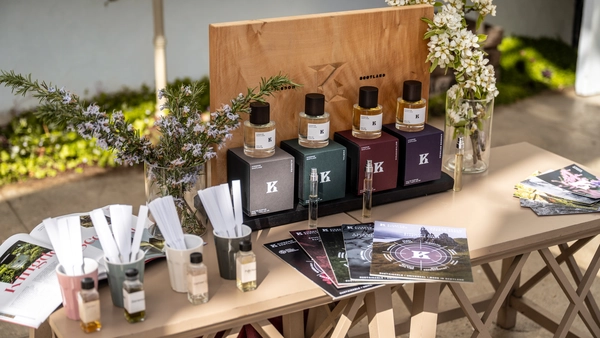
Imogen and I became friends during our time at Glenmorangie and we stayed in touch when we moved on. She developed Kingdom Scotland, creating fragrance inspired by her education in geology and passion for Scotland. The threads of whisky are inherently tangled into the diverse landscapes where they are made.
‘I was struck by the deep connection between whisky and perfume: both born from distillation, both sensory journeys of complexity and craft, and both shaped by the natural ingredients and traditions that give them character.’
Imogen’s idea was to knit these threads together, with storytelling at the heart. My time at art college was spent threading looms to weave cloth. Now the threads are whisky and fragrance entwined together.
https://annabelmeikle.com/wp-content/uploads/2026/05/KOTQ-AM.pdf
One response
Great article Annabel 😺